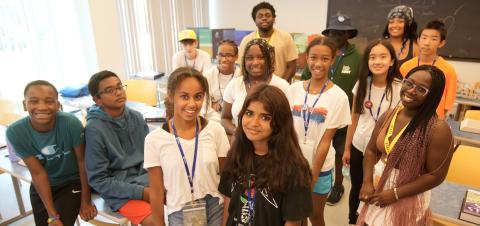
A Program for Students Entering Grades 5-12 | July 20-24, 2026
The Dinah Whipple STEAM Academy is an immersive educational program that explores science, technology, engineering, the arts and mathematics (STEAM), as well as the Black experience. The program will take place on the UNH Durham campus, providing students with access to state-of-the-art facilities, advanced technology and award-winning faculty. It is offered through UNH Tech Camp, which has been providing dynamic, experiential summer programs for middle and high school students for more than a decade. Day and residential options available. The program is free and open to students from all backgrounds.
Summer 2026 Program Information
The academy is named after Dinah Whipple, a significant figure in New Hampshire history best known for founding the state’s first school for Black children in Portsmouth circa 1806. The former enslaved New Hampshire native became a leader in the community, advocate for education and an inspiration for future generations.
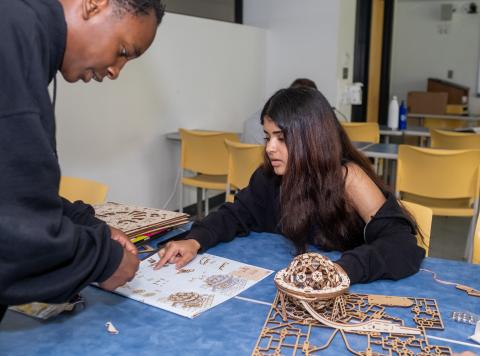
Building on that legacy, students in this program will learn about basic science and engineering principles and disciplines through explorative hands-on activities. Students will get to interact with professional engineers and peer mentors studying in these fields. Along with engineering activities, students will also take a dive into the humanities. They will discuss the Black experience in this country, as well as learn the origins of African empires. Students will be introduced to prominent Black figures in American history and get the chance to discuss how their contributions changed our world today.
This summer, new and returning DWSA campers will have several project options to choose from. Each has a unique science or engineering focus and all will incorporate discussions on Black history and Black contributions to STEM.
The application period closed on March 31, 2026.
2026 Project Descriptions
DWSA Junior Innovators (for students entering grades 5–7)
This project is designed as a hands-on introduction to how science and engineering show up in everyday life. Students will explore the Earth around them—weather, water, land, and natural resources—while also learning how people and communities make choices using limited time and money. Through fun design challenges, simple experiments, and teamwork, students will practice the engineering design process (build, test, improve) and learn how real-world solutions must balance cost, safety, and sustainability. By the end of the week, students will present a mini “community solution” and explain the science behind it in a way anyone can understand.
DWSA Tech Trailblazers (for students entering grades 8-12)
Project 1 — Resilient Communities: Environment, Health and Impact
How do environmental challenges like heat waves, storms, water quality issues, food access, and poor air quality affect people’s health and daily lives—and what can we do about it? In this one-week project, students tackle real-world problems at the intersection of environmental science and human services. They’ll explore how risks are measured and monitored, how food and water systems connect to community health, and why some communities are impacted more than others. Through hands-on investigations and design challenges, students will develop practical, community-centered solutions such as neighborhood cooling strategies, emergency preparedness plans, cleaner water access ideas, or healthier and more resilient food options. By the end of the week, teams will present a resilience plan that combines science, empathy, and actionable recommendations to support people and the environment.
Project 2 — Smart Systems Lab: Robotics, Control and Responsible AI
Ever wondered how robots “know” what to do—or how AI can help systems make smarter decisions? In this one-week project, students will explore the foundations of robotics, control systems, and artificial intelligence through fun, build-and-test challenges. Students will work with sensors and simple automated systems to understand feedback control (how machines adjust based on what they detect), then extend their projects by using data and basic AI ideas to improve performance or make predictions. Along the way, they’ll learn how engineers evaluate accuracy, handle errors, and think responsibly about how AI is used in the real world. Students will present a live demo at the end, as well as a brief explanation of how their system works, what it’s designed to solve, and how they improved it.

Bridging the Diversity Gap
UNH alumna Dzijeme Ntumi is the lead instructor and curriculum designer for the Dinah Whipple STEAM Academy. An engineer for the NH Department of Transportation, Ntumi is committed to bringing more equity and inclusion to STEM education. Read more.

Who Is Dinah Whipple?
Dinah Whipple was a significant figure in NH history best known for founding the state’s first school for Black children. She was also a community leader, advocate for education and an inspiration for future generations. Read more.

Leading by Example
UNH alumnus Aboubacar Konate has overcome many challenges in his life to achieve success as a student and engineer. As a lead instructor in the Dinah Whipple program, he shares not only his expertise in engineering, but also his inspirational personal journey. Read more.
Representation Matters: NH Doctoral Students Share Expertise and Insight
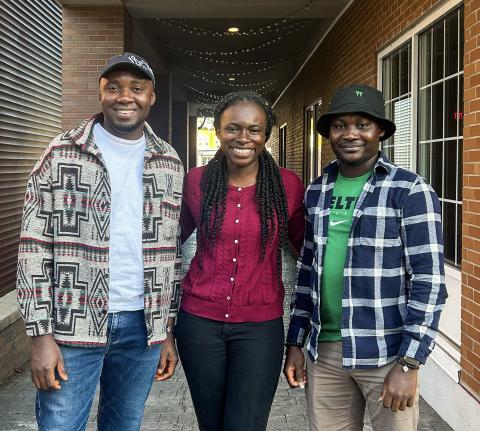
As the Dinah Whipple STEAM Academy continues to grow, Tech Camp is leveraging the expertise of doctoral students from the College of Engineering and Physical Sciences to help lead programs, share their expertise and mentor students.
This past summer, Stella Ansah, King-James Egbe and Femi Olugbon joined the Dinah Whipple team to work with students in grades 8-10. All hail from western Africa and share a passion for STEM education and inspiring young Black students to pursue careers in science and engineering.
“Representation matters,” says Ansah, a native of Ghana who is studying electrical and computer engineering. “All STEM fields benefit from diverse perspectives. Having people of color, especially in rooms where design decisions are being made, allows them to bring their unique lived experiences to the table.”
“Programs like Dinah Whipple play a vital role in breaking down barriers and providing opportunities for underrepresented students to excel in STEM-related fields,” adds Olugbon, a native of Nigeria also studying electrical and computer engineering. “It's not only about education but also about empowerment and creating a brighter, more equitable future for all.”
Over the course of the weeklong program, a variety of science and engineering topics were covered through hands-on activities, collaborative projects and demonstrations. One memorable exercise had the students brainstorm ideas on how to use smart technology to assist individuals with disabilities. They also got a chance to express their creativity through painting exercises and learn about the Black experience and African American history.
Ansah, Egbe and Olugbon all agree that the Dinah Whipple program provides a fertile learning environment for students. “It was fascinating to set the stage for the students and witness their curiosity and creativity blossom,” says Egbe, a native of Nigeria who is studying civil engineering. “It was even more rewarding to observe them develop a newfound appreciation for STEM.”
Olugbon agrees: “The reaction from the students was incredibly positive and enthusiastic. They showed a genuine interest in STEM concepts and were eager to explore and learn. Their curiosity was infectious, and it was rewarding to see them engage with the material and ask insightful questions.”
