
The John Olson Advanced Manufacturing Center is unlike any other. By combining old-fashioned manufacturing skills and techniques with art, history and anthropology, it’s paving the way to show students that hands-on skills have value across disciplines.
One such example is the design and placement of a set of fossilized marine mollusks found during dredge work off the coast of South America. The fossils were donated to UNH by Granite Stater Mark Smith ’82, who inherited the pieces from his stepfather, Walter Nordstrom, whose personal collection included bivalve and gastropod fossils gathered during boat and dredging work for engineering firm Morrison Knudsen in the 1970s and 80s.
The Olson Center fits into this story with the placement and display of the specimens. When the fossils came to the Center in the fall of 2025, staff member Katie Ahearn knew it would be a great feature in the building’s lobby, and worked with senior engineering undergraduate Sarah Souliere ’26 to develop a display. One of the Center’s capabilities is prototyping and 3D printing. The two started with drawings and then CAD software to design and print a display to house the shells.
The specific fossils on display were found during ship dredging in South America (likely Brazil), where they are commonly found due to the geologic history of the region. Millions of years ago, most of South America was covered by shallow seas full of marine life. Mollusks were one of the most common animals in those ancient seas and were easily fossilized due to their calcium carbonate shells.
The display pieces are likely internal molds of snails and clams that formed when sediment filled the shells and hardened before the calcium dissolved, being left behind as the ancient seas receded with the changing planet.
One might ask why common shell fossils warrant a display. Well, they tell us the story of the planet. What was here millions of years ago, what they ate and how they evolved into today’s creatures. They tell the history of the earth—and who doesn’t like a good story?
The Olson Center focuses on hands-on training outside the traditional classroom. Projects like this give UNH students a peek at where their degrees can take them. They also bring together different types of students to show them how manufacturing techniques can converge within their own academic paths. What can an art or history student accomplish with manufacturing? The possibilities are limitless. In this case, the history buff and the engineer, working together, created a space where the fossils can teach—and maybe inspire others.
Special thank you to Professor Elizabeth Harvey
Written by and Photos by Katie Ahearn
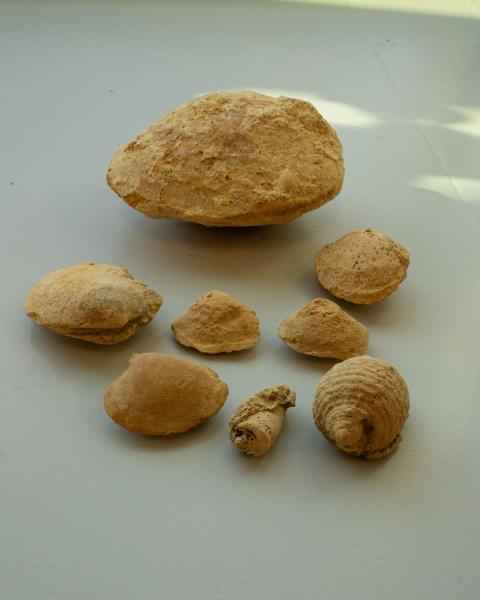
Bivalve and gastropod fossils

